
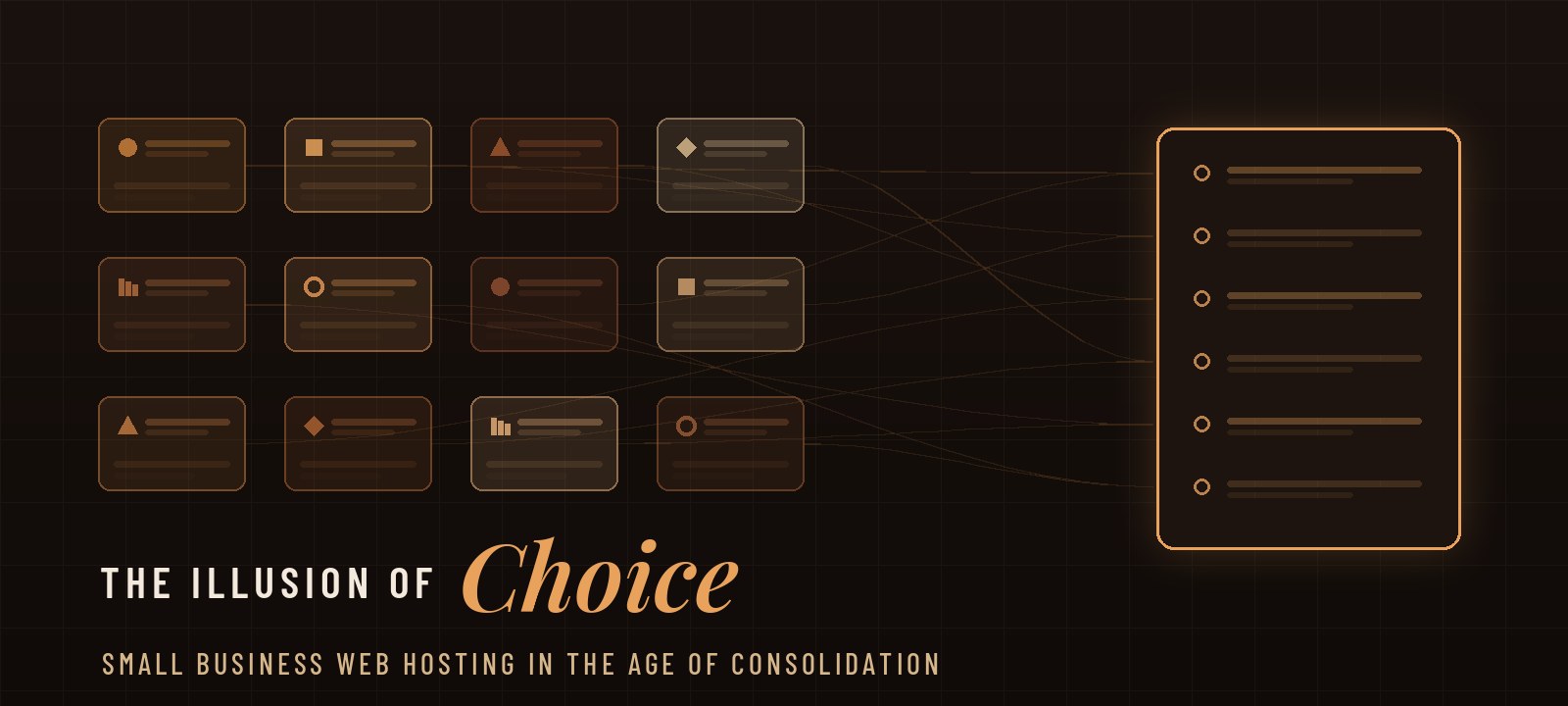
If you have ever moved your website from one big host to another because the service got bad, there is a reasonable chance you never actually left the building. Newfold Digital, formed in 2021 out of the merger between Endurance Web Presence and the Web.com Group, owns Network Solutions, Register.com, Bluehost, HostGator, Domain.com, Crazy Domains, and dozens of other names that present themselves in the marketplace as independent competitors. The company reports serving close to seven million customers worldwide and is backed by the private equity firm Clearlake Capital. Over the past two years that portfolio has been actively collapsing inward: Web.com was folded into Network Solutions in June 2025 and retired as a standalone brand, Register.com followed shortly after, and trade coverage through 2025 and early 2026 has tracked multiple credit rating downgrades on Newfold's debt. GoDaddy, the one genuinely independent giant left in the small business category, has spent the same period rebuilding its support model around AI agents. So when a small business owner sits down to compare hosting providers and feels like there are ten good options, what is actually on the table is closer to two, and neither of them is structured to know who you are.
One company, many logos
This is worth understanding before you sign anything, because consolidation does not change the marketing but it changes almost everything else. When two brands merge, the first thing that goes is duplicated overhead, and support is overhead. The logos stay distinct because brand equity is valuable and because the appearance of a competitive market keeps customers from feeling cornered, but the infrastructure, the billing systems, and increasingly the support organizations get pooled behind them. Industry documentation of the Endurance and Newfold portfolio has long described shared support resources across brands. That is why the experience of switching from one of these companies to another so often feels identical, and why the answer to "we had a bad experience with X so we moved to Y" is frequently that X and Y file the same tax return.
The real price arrives in year two
The pricing follows the same logic. The introductory number is a customer acquisition cost, not a price, and the real price arrives quietly in year two. Forbes Advisor tested this directly with Network Solutions by contacting support and asking what a plan advertised at $2.95 per month would renew at, and was told that pricing could not be provided without account information, meaning a customer would have to sign up before learning what they were signing up for. The reviewers eventually located the renewal figure buried in a disclaimer page hosted elsewhere on the site. Independent comparisons put Network Solutions domain renewals well above the industry average. None of this is fraud and all of it is disclosed somewhere, but it tells you what the relationship is built around, which is the volume of accounts rather than the health of any one of them. We saw the same pattern play out when Squarespace raised its prices: the number you sign up at is never the number you stay at.
When a person is the exception path
What has changed most recently is who picks up. GoDaddy has moved its support model toward agentic AI, first with Ask Airo and then with the broader Airo.ai platform, which the company describes as a framework that determines the next best action for a customer and executes it, with a process for handing off to a human when the AI cannot complete the task. Set aside whether the technology is good, because a lot of it is. The structural point is that a human being is now the exception path rather than the default, and the exception path is the one that gets measured, budgeted, and squeezed. For a business owner whose checkout page is down at four o'clock on a Friday, the difference between a system that routes you to a person and a system that decides whether to route you to a person is the entire product.
What a small host does differently
Here is what a small, independent host does differently, and it is not really about technology. It is about the ratio. When a hosting company has seven million customers, you are a row in a database and the only rational way to serve you is to build a system that resolves the most common ninety percent of tickets without a person touching them. When a hosting company has a few hundred clients, the founder can plausibly know what runs on every one of them. That means the person answering the phone already knows that your site runs a particular caching setup, that your last outage was a plugin conflict after an update, that your backups run nightly and where they go, and that your busiest sales week is the first week of December. Nobody has to rediscover your stack from scratch every time something breaks, because nobody ever forgot it.
The moments that actually cost money
That difference shows up most clearly in the moments that actually cost money. Every host sells backups. Very few will run the restore for you, on the phone, while you stay on the line. Every host will tell you your site is up, because uptime is measured in a way that makes it easy to say yes. Fewer will notice that your contact form has been silently failing for three weeks because a DNS record drifted after a mail change, which is the kind of problem that never generates an alert and never gets fixed until a human who cares about your business happens to look. Migrations are the same story. A large host will give you a self-service tool and a knowledge base article. A small host will do the migration, verify the redirects, watch the error logs for a week, and tell you what they found.
There is also a plain practical argument about where the people are. Support quality correlates less with geography than with tenure and authority, but time zones are real and so is the ability to escalate. A US-based technician who is in the same business day as you, who can answer a text message, and who has the credentials to actually change something on the server rather than file a request with another team, resolves in ten minutes what a tiered offshore queue resolves in three days. That is not a knock on any individual support agent working a script in a call center, most of whom are constrained by permissions rather than ability. It is a knock on a system that is designed to prevent the person you reach from being able to help you.
A business risk, not a preference
The last thing worth saying is that this is a business risk question, not a preference question. Your website is where your customers find your hours, your phone number, your booking form, and your payment page. If it goes down for a week, you do not get that week back. When the company holding that asset is carrying downgraded debt, consolidating brands to cut costs, and moving its front line to automation, the direction of travel for service is not ambiguous. You can decide that the risk is acceptable and the price is worth it, and for a simple brochure site it might be. But you should decide that on purpose rather than because the market looked competitive from the outside.
Four questions to ask your host
If you want to test where you currently stand, the questions are simple. Who answers when you call, and can that person change something on the server without escalating? What does your plan renew at, and can you find the number without logging in? If your site went down right now, how long before someone who has seen it before is looking at it? And if you moved to the competitor you would most likely move to, would you actually be changing companies?
If you would rather not guess at the answers, ours are public. Our rate card lists what hosting costs and what it renews at, and the person who replies is the person who runs the servers.